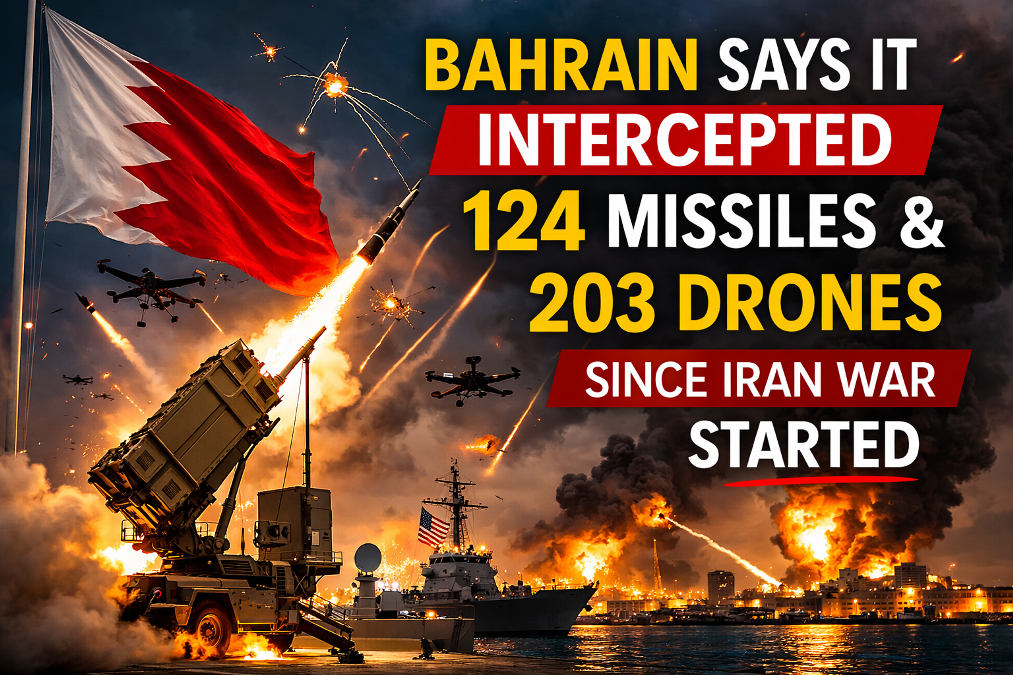
Bahrain has revealed that its air defence systems have intercepted 124 missiles and 203 drones since the start of the ongoing war involving Iran, highlighting the intense pressure Gulf countries are facing as the regional conflict continues to escalate. According to the Bahraini Ministry of Defence, the interceptions were carried out over the past two weeks as Iranian missile and drone attacks spread across several countries in the Middle East.
The small Gulf kingdom, which hosts the United States Navy’s Fifth Fleet, has become one of the key strategic locations targeted during the conflict. Bahraini officials say their defence forces have been working continuously to protect the country’s airspace from incoming threats.
Bahrain on the Frontline of the Regional Conflict
Since the war began, Iran has launched a series of missile and drone attacks targeting Israel as well as several Gulf states believed to be supporting the United States and its allies. Bahrain, because of its close military cooperation with Washington and the presence of American naval forces on its territory, has become a potential target.
Military officials in Manama said their air defence systems have successfully detected and destroyed dozens of aerial threats before they could reach populated areas or critical infrastructure.
The Bahraini Defence Forces stated that the use of missiles and drones against civilian areas and infrastructure represents a serious violation of international law and threatens the safety of citizens and residents in the region.
Role of US Military Presence
Bahrain hosts the headquarters of the US Navy’s Fifth Fleet, which oversees American naval operations in the Persian Gulf, the Red Sea, and parts of the Indian Ocean. Because of this strategic military presence, Bahrain has long been considered an important security partner for the United States.
The naval base located in the capital Manama plays a crucial role in monitoring maritime security in the region, particularly around the Strait of Hormuz, one of the world’s most critical oil shipping routes.
The presence of American forces has also made Bahrain a potential target for Iranian retaliation during the current conflict.
Air Defence Systems Working Around the Clock
Bahraini officials say their air defence network has been operating at a high level of alert since the beginning of the war. The systems used to intercept incoming missiles and drones include advanced radar technology and missile defence systems capable of tracking and neutralizing aerial threats.
According to defence experts, Gulf countries including Bahrain rely heavily on US-supplied Patriot missile defence systems and other advanced air defence technologies to intercept incoming projectiles.
Despite the high interception rate, officials warn that the volume of attacks poses a continuing challenge for defence systems.
Wider Regional Attacks
The attacks targeting Bahrain are part of a broader wave of missile and drone strikes launched across the Middle East during the ongoing conflict.
Iranian attacks have also targeted locations in Saudi Arabia, the United Arab Emirates, Kuwait, and Israel, creating one of the most dangerous regional security crises in recent years.
Several countries in the Gulf region have reported intercepting dozens or even hundreds of drones and missiles since the start of the war.
The use of drones in particular has increased significantly in modern conflicts because they are cheaper to produce and can be deployed in large numbers.
Damage and Casualties
Although many of the missiles and drones have been intercepted, some debris from destroyed projectiles has fallen inside populated areas, causing injuries and damage to property.
Reports indicate that explosions and falling debris have damaged buildings and infrastructure in parts of Bahrain since the conflict began.
Earlier incidents included strikes that targeted areas near Bahrain International Airport and oil facilities, raising concerns about the vulnerability of energy infrastructure in the region.
The Bahraini government has urged citizens to remain calm and follow safety instructions issued by authorities during air defence operations.
Impact on Global Energy Markets
The conflict has also had significant consequences for global energy markets.
The Persian Gulf region produces a large portion of the world’s oil supply, and any instability in the region can quickly affect international oil prices.
The situation has become even more concerning due to tensions around the Strait of Hormuz, a narrow waterway through which roughly 20 percent of global oil shipments pass.
Security threats to shipping lanes in the region have caused oil prices to surge and raised fears of a broader global energy crisis.
Regional Defence Cooperation
The growing number of missile and drone attacks has also led to increased military coordination among Gulf countries and their international allies.
Air defence networks across the region are sharing radar data and intelligence to detect incoming threats earlier and improve interception capabilities.
Experts say this cooperation is crucial in defending against large-scale drone attacks that can overwhelm individual defence systems.
Diplomatic Efforts to De-Escalate
While military operations continue across the region, diplomatic efforts are also underway to prevent the conflict from escalating further.
International organizations and several global powers have called for restraint and urged all parties involved to pursue negotiations to avoid a wider regional war.
However, with missile strikes, drone attacks, and retaliatory operations continuing across multiple countries, the situation remains highly volatile.
Conclusion
Bahrain’s announcement that it has intercepted 124 missiles and 203 drones since the start of the Iran war underscores the scale of the security challenges facing Gulf states.
The small island nation has found itself on the front lines of a rapidly expanding regional conflict due to its strategic location and close ties with the United States.
As long as hostilities continue between Iran, Israel, and the United States, Bahrain and other Gulf countries are likely to remain under threat from missile and drone attacks.
The coming weeks will be critical in determining whether the region moves toward de-escalation or faces a prolonged period of instability and military confrontation.